The difference between a software team that ships weekly and one that ships every quarter usually isn’t the quality of their code — it’s their DevOps practices. DevOps is the set of cultural practices, processes, and tools that eliminate the friction between writing code and delivering value to users. Here’s what it actually involves and why it matters in 2026.
What DevOps Actually Means
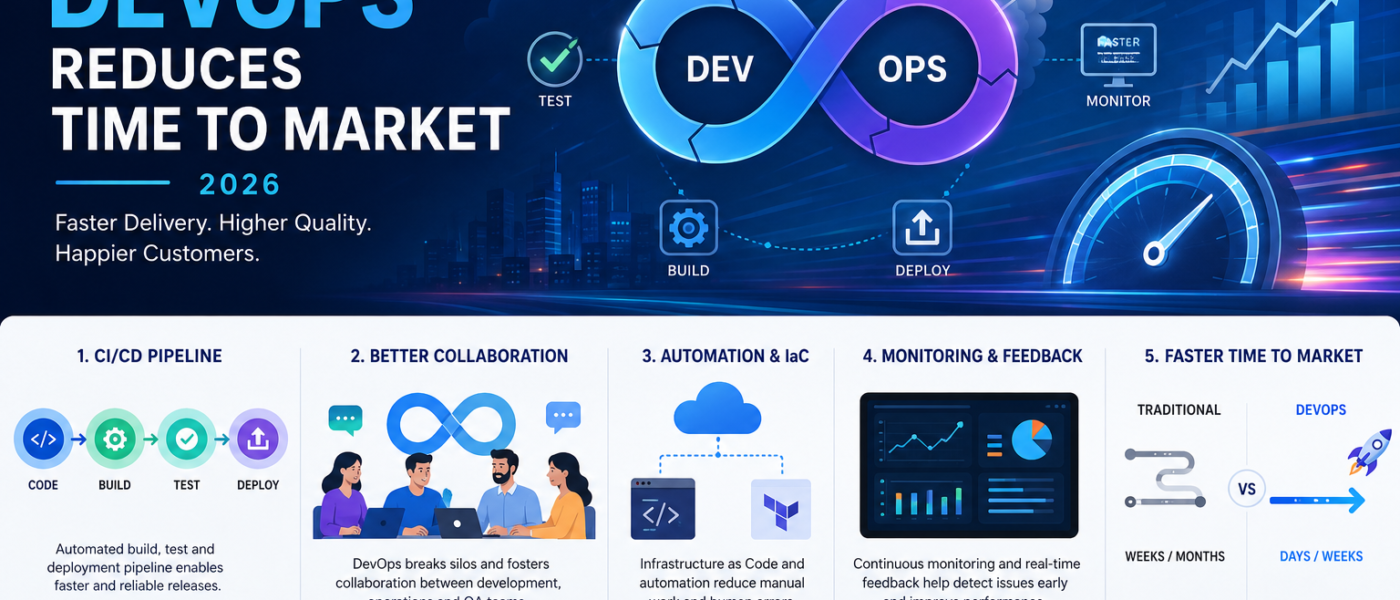
DevOps is the combination of development (Dev) and operations (Ops) practices designed to shorten the software delivery lifecycle. In practice, it means: automated testing that runs on every code change, automated deployment pipelines that release code without manual steps, infrastructure managed as code (version-controlled, reproducible), and monitoring that alerts before users are impacted.
The cultural component matters as much as the tools: Dev and Ops teams working together, sharing responsibility for production reliability, rather than “throwing code over the wall” from development to operations.
The Core DevOps Practices
Continuous Integration (CI)
Every code change triggers an automated build and test suite. If tests pass, the change is ready to deploy. If they fail, the developer is notified immediately. CI eliminates the “integration hell” that happens when developers merge months of divergent work at once.
Continuous Delivery (CD)
Automated pipelines take code from the CI system through staging environments, additional test suites, and (with CD) all the way to production — automatically, or with a single human approval click.
Infrastructure as Code (IaC)
Infrastructure (servers, databases, networking) is defined in code (using Terraform, Pulumi, or AWS CloudFormation) and version-controlled. Any environment can be reproduced identically in minutes — staging, production, disaster recovery.
Monitoring and Observability
Production systems emit logs, metrics, and traces that give the team visibility into application behaviour. Alerts fire when something degrades before users notice. This is what enables teams to release with confidence rather than fear.
Measurable Impact on Delivery Speed
The DORA (DevOps Research and Assessment) research programme has tracked DevOps performance for a decade. Elite DevOps performers (the top 25%) demonstrate:
- Deployment frequency: Multiple times per day vs once per quarter for low performers
- Lead time for changes: Less than one hour vs one to six months
- Change failure rate: Under 5% vs 46–60%
- Recovery time: Less than one hour vs one week to one month
The performance gap between elite and low-performing teams is not marginal — it’s two orders of magnitude.
Getting Started: A Practical Path
If your team has no CI/CD today, the highest-impact first step is a CI pipeline: every commit triggers automated tests. This alone reduces bug escape rates and forces test coverage discipline. Second step: automated deployment to staging. Third step: automated deployment to production with confidence gates. These three steps alone transform delivery velocity.
Tools in the 2026 DevOps Stack
- CI/CD: GitHub Actions, GitLab CI, CircleCI
- Infrastructure as Code: Terraform, Pulumi
- Containers: Docker, Kubernetes (managed: EKS, GKE, AKS)
- Monitoring: Datadog, Grafana + Prometheus, New Relic
- Secret management: HashiCorp Vault, AWS Secrets Manager
WavesItSolution sets up and maintains production DevOps infrastructure for development teams at all stages. See our Cloud & DevOps services or book a DevOps assessment.